I have cities to compare
Start with your birth data, generate the map, add up to four cities in Compare Cities on the map, then confirm finalists with the relocation chart (one city per run).
Use this guide to turn your astrocartography map into a practical where-to-live decision workflow: start with your birth data, compare candidate cities, match planetary lines to your life goals, and keep real-world relocation factors in the picture.
Choose your path
Both paths use tools that already exist on Astrocarto.org. Pick the workflow that matches whether you already have candidate cities.
Start with your birth data, generate the map, add up to four cities in Compare Cities on the map, then confirm finalists with the relocation chart (one city per run).
Generate your map first, scan planetary lines globally, and use Check City when a place catches your interest.
The sample birth details below are for illustration only. Repeat the same clicks with your real birth date, time, and birthplace.
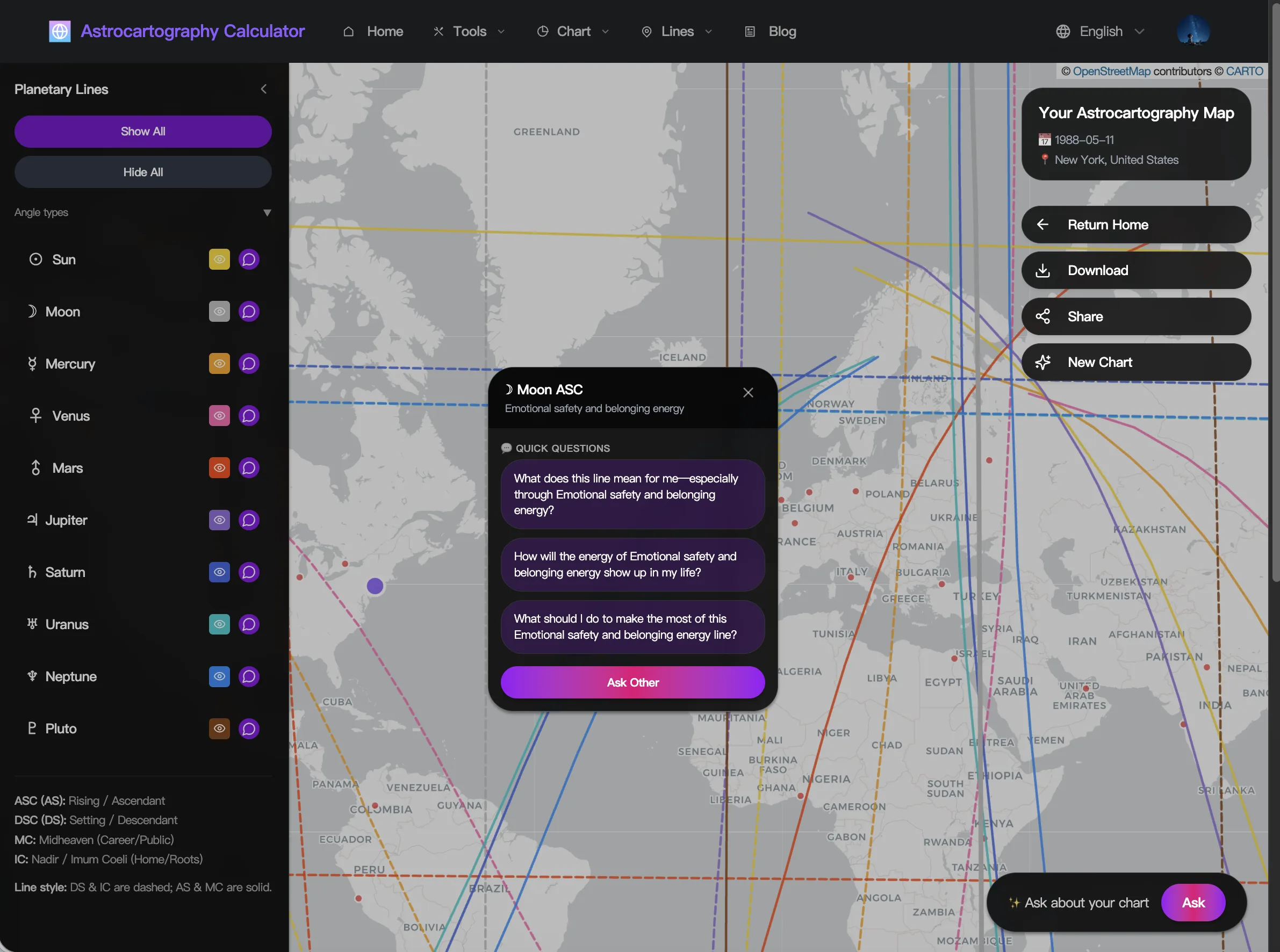
Example: 1990-06-15, 14:30, Los Angeles, CA — or use your own data on the homepage generator.
Open the interactive map from the homepage. Guest users have a daily map limit; sign in for more sessions.
Try Compare Cities with illustrative picks such as Singapore, Tokyo, and Vancouver (plus your current city as a baseline). Read nearby lines and angles on the map—career research often starts with Sun MC, Jupiter MC, or Mercury MC themes, but results depend on your full chart.
For each finalist, run the free relocation chart once per city. Then verify visas, jobs, housing, and cost of living—astrocartography does not replace practical planning.
These tools answer different questions. Use both for serious relocation research.

Astrocartography cannot choose a city for you by itself, but it can give you a useful symbolic map for comparing places. When you enter your birth date, exact birth time, and birth place, your map shows where each planet in your natal chart was angular around the world. Those lines can help you understand which locations may emphasize visibility, comfort, love, discipline, momentum, or growth.
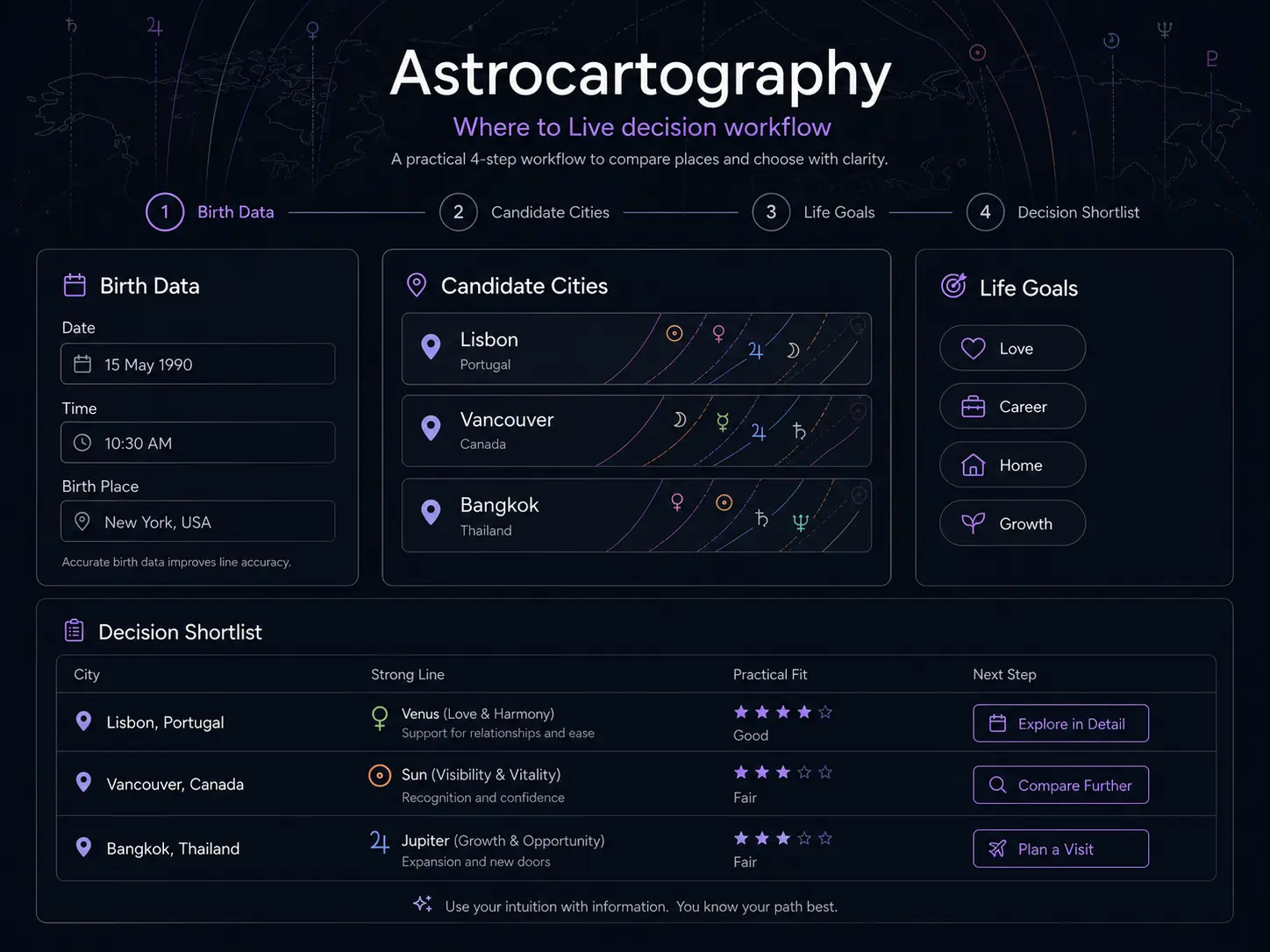
A where-to-live reading begins with accurate birth data: date, time, and birth place. The birth time matters because the Ascendant, Descendant, Midheaven, and IC angles shift quickly. Once your map is generated, add a few candidate cities instead of looking at the entire world at once. This keeps th...

The strongest use of astrocartography for relocation is goal matching. If you want career visibility, Sun or Jupiter Midheaven lines may be worth studying. If you want beauty, ease, social connection, or partnership, Venus lines are usually relevant. If you want emotional belonging and a settled hom...

Relocation decisions involve work, housing, visas, healthcare, family, culture, safety, and money. Astrocartography can add a personal chart-based layer to that research, but it should not replace practical planning. A beautiful Venus line in a city with no job fit may still be unrealistic. A seriou...
There is no single best astrocartography line for everyone. A good place to live depends on what you want the location to support. Use these three broad patterns to narrow your map before you compare individual cities.

Instead of scanning the whole map and hoping one city jumps out, use a simple comparison process. It keeps your reading grounded and makes the result easier to discuss with an AI interpretation or a professional astrologer.
Start with the free astrocartography calculator and enter your birth date, exact birth time, and birth place. If you do not know your birth time, treat the result as exploratory because the angles may shift. Save or note the lines near each city you are considering.
Choose places you could actually visit, work in, study in, or move to. Include your current city as a baseline. Comparing a dream city, a practical city, and your current location often reveals the most useful contrast.
Give every city a primary purpose: career, love, home, study, healing, creativity, or reinvention. Then read the planetary lines through that lens. A Mars line may be excellent for ambition but less ideal for rest. A Moon line may be excellent for belonging but less focused on public achievement.
For a finalist city, run a relocation chart to see how your natal planets shift into houses in that location. Astrocartography shows the geographic line pattern; the relocation chart gives a city-specific chart view. Together, they give a clearer picture than either method alone.
Use these goal-based prompts when reading your astrocartography chart. They help you turn a map full of lines into a more specific location shortlist.
Prioritize cities near Sun MC, Jupiter MC, Mercury MC, or Mars MC depending on your work style. Sun supports visibility, Jupiter supports expansion, Mercury supports communication and knowledge work, and Mars supports drive. Then ask whether the city also has a realistic market, network, salary path, or client base for your career.
Look at Venus DSC, Moon DSC, Venus ASC, and sometimes Jupiter DSC. These placements can describe relationship-centered themes, but they do not remove the normal requirements of compatibility, timing, communication, and emotional maturity. A good love location still needs real-life social opportunity.
Study Moon IC, Venus IC, and supportive fourth-house themes in the relocation chart. Also notice how your body responds when you visit. A home line may feel gentle, familiar, nostalgic, protective, or emotionally revealing. The right home place often has both symbolic support and practical daily ease.
Mercury lines are useful for learning, teaching, networking, writing, sales, media, and business communication. Mercury MC is especially relevant for public work, while Mercury ASC can make it easier to meet people and exchange ideas. Watch for overstimulation if you need deep rest.
Uranus, Neptune, and Pluto lines can be powerful but less predictable for long-term living. Uranus can bring freedom and disruption. Neptune can bring inspiration and confusion. Pluto can bring intensity and transformation. These lines deserve extra care, short visits, and practical backup plans before any major move.
A city without strong nearby lines is not a bad choice. It may feel neutral, flexible, or easier to shape through your own choices. For many people, a low-intensity place is better for stability, family, recovery, or steady work than a dramatic line crossing. Neutral can be a feature, not a flaw.
Practical answers for using astrocartography to compare places without turning the map into a guarantee.
Generate your map on the homepage, compare up to four candidate cities in the map tools, and run a free relocation chart for each finalist. Deeper AI map chat and city comparison reports use credits.