How to Read Your Astrocartography Map: Beginner Quick-Start Guide (2025)
How to Read Your Astrocartography Map: Beginner Quick-Start Guide
Quick answer: To read your astrocartography map, (1) generate your map with accurate birth data, (2) identify which planetary line runs closest to a city, (3) check whether that line is ASC, DSC, MC, or IC, and (4) interpret the planet's theme in that location. This guide walks you through each step in plain language.
If you already know what astrocartography is but staring at a world map full of colored lines feels overwhelming, you are in the right place. How to read an astrocartography map is a learnable skill—you do not need to memorize every symbol on day one.
This article is a short, practical entry point. For a full deep dive into angles, power spots, and relocation planning, see our complete astrocartography map interpretation guide.
What You Need Before Reading Your Map
Accurate map reading starts with accurate input. Gather these three details before you open any astrocartography calculator:
| Data | Why it matters |
|---|---|
| Birth date | Sets planetary positions |
| Birth time | Required for angle lines (ASC, MC, IC, DSC) |
| Birth location | Anchors your chart to a place on Earth |
No exact birth time? You can still explore some themes, but angle lines may be approximate. If possible, check your birth certificate or hospital records first.
Generate your map: Use our free astrocartography calculator to create your personalized world map. The tool plots your planetary lines using Swiss Ephemeris data—the same astronomical standard used in professional astrology software.
Step 1: Understand What You Are Looking At
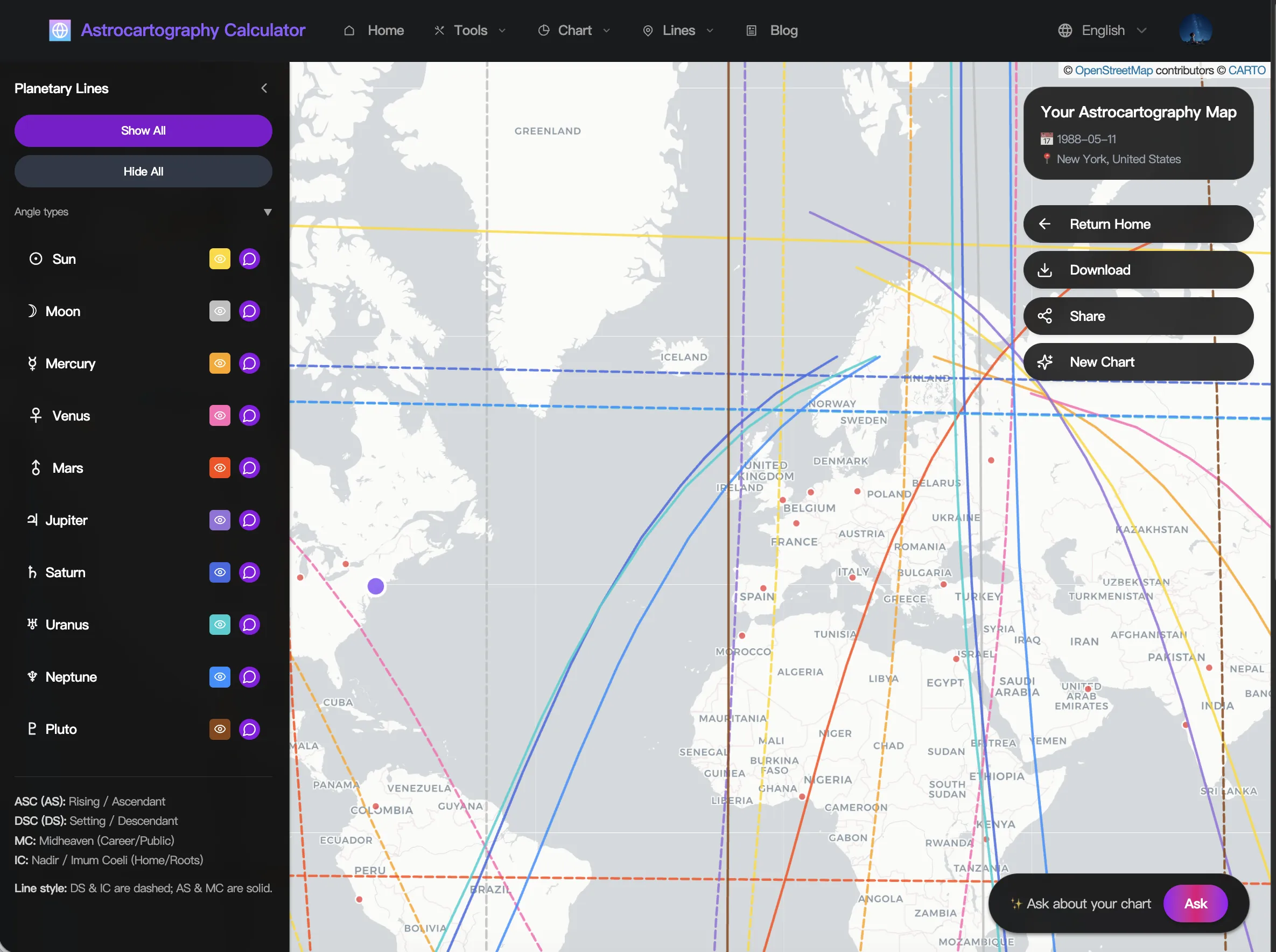
An astrocartography map is a world map with lines, not a regular birth chart wheel. Each line shows where a specific planet was angular—rising, setting, overhead, or at the nadir—at your birth moment, projected onto Earth's surface.
The three visual elements every beginner should notice:
- Planetary lines — Each planet (Sun, Moon, Venus, Mars, Jupiter, Saturn, Mercury, and outer planets) creates up to four lines across the globe.
- Line labels — Look for planet symbols and angle abbreviations (ASC, DSC, MC, IC). If symbols are unfamiliar, bookmark our astrocartography symbols meaning guide.
- Your location markers — Cities you care about (current home, dream destination, past favorites) compared against nearby lines.
Key insight: You are not reading "good" or "bad" cities in absolute terms. You are reading which life themes become louder in which places.
Step 2: Learn the Four Angles (The Reading Framework)
Every planet produces four line types. The planet tells you the theme; the angle tells you the life area where that theme shows up.
| Angle | Full name | Life area | Simple question it answers |
|---|---|---|---|
| ASC | Ascendant | Identity, body, first impressions | "Who do I become here?" |
| DSC | Descendant | Relationships, partnerships | "Who do I attract here?" |
| MC | Midheaven | Career, reputation, public life | "How am I seen professionally here?" |
| IC | Imum Coeli | Home, roots, private life | "Where do I feel at home here?" |
Example
If your Venus MC line runs through Lisbon, Venus themes (love, beauty, harmony, social ease) may express strongly in your public and professional life in that region—not only in romance.
If the same Venus appears on your IC line elsewhere, the emphasis shifts to home, family, and emotional comfort.
Same planet, different angle, completely different reading. This is the core skill behind astrocartography map reading.
Step 3: Pick Your Goal, Then Pick Your Lines
Beginners get lost when they try to read every line at once. Start with one life goal and only the planets that commonly support it.
| Your goal | Start with these lines | Why |
|---|---|---|
| Career growth | Sun MC, Jupiter MC, Saturn MC | Visibility, opportunity, mastery |
| Love & social life | Venus DSC, Venus ASC, Moon DSC | Attraction, warmth, emotional bonding |
| Relocation & home | Moon IC, Venus IC, Sun IC | Comfort, belonging, personal renewal |
| Study & communication | Mercury MC, Mercury ASC | Learning, writing, networking |
| Adventure & change | Jupiter ASC, Uranus lines | Expansion, breakthroughs |
Exercise (5 minutes): Circle one goal above. Find the matching lines on your map. Write down the top three cities each line passes through. That short list is your first meaningful astrocartography reading.
Step 4: Evaluate Any City in Four Questions
Once you have a city in mind—Barcelona, Tokyo, Austin, anywhere—run it through this checklist:
Question 1: Which line is closest?
The nearest planetary line is usually the dominant influence. If multiple lines converge within a few hundred miles, you are looking at a power spot (covered in depth in our map interpretation guide).
Question 2: Which planet is it?
- Sun — confidence, visibility, vitality
- Moon — emotions, comfort, routines
- Venus — pleasure, aesthetics, connection
- Mars — drive, competition, physical energy
- Jupiter — growth, luck, opportunity
- Saturn — discipline, responsibility, long-term building
- Mercury — ideas, commerce, communication
For planet-by-planet line guides, explore our astrocartography lines hub.
Question 3: Which angle is it?
Use the ASC / DSC / MC / IC table in Step 2. This step prevents the most common beginner mistake: reading "Venus in Paris" without specifying how Venus expresses there.
Question 4: How far are you from the line?
| Distance | Typical effect |
|---|---|
| On the line (±50 mi / 80 km) | Strongest expression |
| Moderate range (50–200 mi) | Clear but softer |
| Far (200+ mi) | Background tone, not dominant |
You do not need to live exactly on a line to feel its influence, but closer generally means stronger.
Step 5: Write Your First Location Summary
Template you can copy into a notes app:
City: ________ Closest line: [Planet] [Angle] Distance: ________ Likely theme: ________ Best for: career / love / home / study / adventure Questions to validate: What happened when I visited? What do locals embody?
Realistic expectation: Astrocartography describes environmental tone, not guaranteed events. Use it to shortlist places, then confirm with visits, job research, cost of living, visa rules, and personal comfort.
Common Beginner Mistakes When Reading a Map
❌ Reading only "good" planets
Saturn and Mars lines are not curses. Saturn can support career mastery; Mars can fuel athletic or entrepreneurial drive. Context and angle matter more than hype.
❌ Ignoring birth time accuracy
A 30-minute birth time error can shift angle lines significantly. Treat near-line conclusions as directional, not forensic, if your birth time is uncertain.
❌ Expecting one city to fix everything
Most people benefit from different lines for different goals. Your Jupiter line city might be perfect for business while your Moon line city feels like home.
❌ Skipping real-world research
Astrocartography is a decision-support tool, not a replacement for visas, housing markets, language, safety, or family needs.
Frequently Asked Questions
How long does it take to learn how to read an astrocartography map?
Most beginners can complete a basic city reading in 15–30 minutes after generating a map. Deeper interpretation—power spots, transits, combining with your natal chart—takes longer and is covered in our advanced interpretation guide.
Do I need to know astrology first?
No. You only need to learn planet themes, four angles, and distance zones—all covered above. Symbol fluency helps but is optional on day one.
What is the difference between this guide and a full interpretation tutorial?
This page is a quick-start workflow. Our astrocartography map interpretation article goes much deeper into power spots, AI-assisted reading, relocation planning, and advanced examples.
Can I read a map for travel, not moving?
Yes. Many people use astrocartography to choose vacation cities, conference locations, or semester-abroad destinations where specific energies (creativity, romance, rest) are easier to access.
Your Next Steps
- Generate your map → Free astrocartography calculator
- Learn the symbols → Astrocartography symbols meaning
- Go deeper → Complete map interpretation guide
- Understand the concept → What is astrocartography?
Related Articles
- What is Astrocartography?
- Astrocartography Map Interpretation (Advanced)
- Astrocartography Symbols Meaning
- How Does Astrocartography Work?
- Sun Line Astrocartography
- Venus Line Astrocartography
Keywords: how to read astrocartography map, read astrocartography map, astrocartography map for beginners, planetary lines, ASC line, DSC line, MC line, IC line, astrocartography calculator, relocation astrology
Last updated: July 2025
Generate your free astrocartography chart on the world map.
Free Astrocartography Chart & Map →